12 August 2014

The Explainer: Gaza, Hamas, & Israel - Part I

This is the first of the Gaza Explainers.
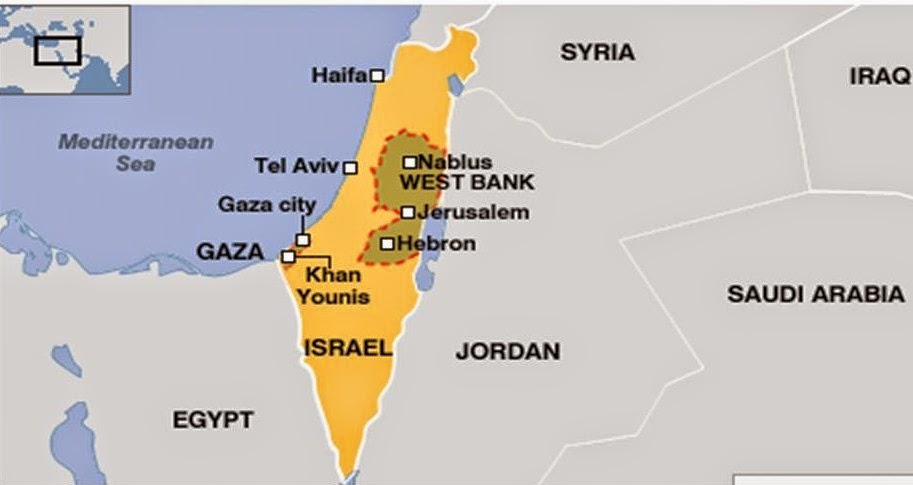
What is Palestine?
Palestine, almost entirely populated by Muslims, comprises two major chunks of territory: West Bank and Gaza Strip.
West Bank
At 3,620 sq. km., West Bank is the larger of the two Palestinian territories. The territory has a population of 2.44 million, with an additional 2.6 lakh Israeli settlers.

West Bank, located between Israel and Jordan, was occupied by Israel in the 1967 Six-Day War.

Currently, West Bank is under the control of Palestinian Authority (PA), which is a direct political rival of Hamas.


Gaza Strip
Gaza Strip is a narrow stretch of land (of about 360 sq. km.) located between Israel and Mediterranean Sea, with Egypt on the south. It has an estimated population of 16 lakh. Occupied by Israel in the 1967 Six-Day War, Gaza is controlled by Hamas.

Is Palestine an independent country?
No. Let’s put it this way. Palestine is more of a territory fighting for independence from Israeli occupation of some parts of its territory. Palestine is not sovereign in the true sense of the term; large swathes of its territory are controlled by Israel, including within the West Bank, where there are Jewish settlements.

What about Hamas?
In 1987, radical Islamist Sheikh Ahmed Yassin founded Hamas, an acronym of the Harakat al-Muqawama al-Islamaiyya (Islamic Resistance Movement).

The birth of Hamas can be attributed to the aspirations of extremist Palestinians to build a movement like Hezbollah, an extremist Shia Muslim outfit which operates out of Lebanon.
These extremist elements felt that there should be a similar home-grown Sunni movement, i.e., one that would operate from Palestinian soil.

What does Hamas think about Israel?
Hamas does not recognise the existence of Israel. In fact, Hamas denies the latter’s right to exist. One unique feature of Hamas is that it lays great emphasis on religion, which is in serious contrast to the secular Fatah party, which rules the West Bank.
Hamas’ charter explicitly mentions that the fundamental aim of its existence is the destruction of the State of Israel and the establishment of a sovereign Palestine.

In short, Hamas is a radical Sunni extremist group, which is anti-Israel and one which is fighting for an independent, sovereign Palestine.

Who supports Hamas?
From its inception and till recently, Hamas was funded by Iran and Syria and a range of Islamic charities, many of which are listed as fronts for Islamic terror groups, and are hence banned in many countries of the world.

The irony is that both Iran and Syria are controlled by Shia Muslims while Hamas is a radical Sunni Islamist organisation. Iran and Syria also do not recognise the State of Israel; Iran has repeatedly called for ‘wiping Israel off the map of the world’.

However, since the beginning of the civil war in Syria a lot has changed in the political equations involving Hamas.

For several years, Hamas ran a major office in the Syrian capital, Damascus. However, the deeply sectarian conflict in Syria has impacted the Hamas-Iran-Syria equation as well.

Short backgrounder on Syrian conflict
Syria is predominantly populated by Sunni Muslims while the president, Bashar al-Assad, is a Shia Muslim, backed by Iran (the world’s biggest Shia Muslim country).


Read The Explainer: Syrian Crisis Part I and Syrian Crisis Part II.

As the Sunni rebel movement against the Shia ruling dispensation gathered pace, Hamas, a Sunni radical group, found itself in a difficult situation. In this sectarian conflict, Hamas’ natural sympathies lay with the Sunni rebels in Syria. Unable to digest the fact that its principal backers, Syria and Iran, are waging a relentless campaign against Sunni rebels, Hamas moved out of Damascus. It is also believed that Hamas was forced to move out of Damascus by the Syrian regime itself.

Hamas shifted base to Doha, capital of Qatar, a Sunni kingdom. Qatar is stridently anti-Iran and anti-Syria (read anti-Bashar). Today, Qatar has emerged as the principal political and financial backer of Hamas.


More short Explainers on the Gaza Crisis to follow. 

20 July 2014

India's Silent Muslim Community

The Middle East has rarely experienced peace. Violence - religious and sectarian - permeates almost all societies in probably what is the most divisive region in the world.

Currently, there are three major conflicts happening in the region: Syrian civil war (between President Bashar al-Assad, a Shia and backed by Iran, and Sunni rebels, backed by Saudi Arabia and other Sunni nations); Iraq (between Shia-dominated government and an umbrella of ultra-extremist Sunni terrorist groups, including the Islamic State), and Israel-Palestine (a decades-old festering conflict between the State of Israel and the militant group Hamas).

I do not condone violence. In fact, violence in the name of religion, caste, sect and other discriminatory dividers is the worst thing that can happen in any society.

The violence in Iraq and Israel has brought to the fore the hypocrisy of the so-called secular parties and deep schism in the Indian Muslim community.

Indian Muslim Community
In Jammu and Kashmir, Muslim protesters railed against Israel accusing it of using violence against Palestinians. The stone-pelting and shrill slogan-mongering protesters lambasted the Jewish state for killing Muslims.

But these slogan-mongering protesters said nothing about the carnage wrought by the Islamic State (formerly called the ISIS) against non-Sunni groups: Shia Muslims, Christians and others. 

Why? Is it ok for Muslims to kill other Muslims, just because they belong to a different sect? Why are there no sane voices in the Indian Muslim community protesting the despicable actions of the Sunni extremist groups against of the minority Shia groups and Christians? 

How many Indian Muslim leaders have condemned the violence in Iraq? How many have registered protest against the mass killings of Shia Muslims by extremist Sunni Muslims? 

Larger Muslim World
Strangely, the global Muslim community is eerily silent on both the crises: Israel-Palestine and Iraq. 

How many countries have come to the rescue of the Palestinians? Except for some murmurs of hollow protest, no Muslim country, including Saudi Arabia and Iran, the so-called leaders of the Muslim world, have come to the aid of the hapless Palestinians? Have not the major Muslim powers abandoned the Palestinians to their luckless fate?

India's Secular parties
In India, we have a strange political strain: self-declared political parties try to outdo each other to prove their secular credentials (read 'pro-Muslim bent').

Eager to outdo each other to score brownie points with the large Muslim community (read 'vote bank'), the Congress and its ilk (like the Samajwadi Party) created a ruckus in the Parliament demanding a discussion on the precarious Gaza situation. These secular parties blasted Israel for using extreme violence against the Palestinians. But they were silent on the use of extreme violence by militant groups, Hamas and the Islamic Jihad, against Israel.

And what did they have to say on the volatile situation in Iraq? Nothing. That does not warrant any discussion. Maybe because it involves a sectarian angle -- Sunnis versus Shias. 

It is said that there is collateral damage in any conflict. The death of innocents, especially those of children and women, is distressing. Death has no name. It can not have. Only we, as humans, have assigned the colours of religion, caste and sect, to the blood that runs in us. Divisiveness breeds hatred and discrimination.

One can understand that political parties can stoop to any level to garner votes. But is it right for the Muslim community, both local and global, to adopt different yardsticks for different conflicts -- yardsticks of religion and sect?


Sunday Reads - PM's Dangerous Air India One + Builder of Silicon Valley


  • Why Air India One (Indian PM's aircraft) is a sitting duck for missiles.(India Today)
  • The secretive billionaire who built Silicon Valley. (Fortune)
  • First landing of humans on the Moon. (Atlantic)
  • Pakistan and China: A precarious friendship? (Diplomat)

Bonus: The WaPo has a highly informative feature on 'how high a missile can reach'. 


13 July 2014

Sunday Reads - India-China Friendship is a Lie + The Curse of Organised Religion


  • India-China friendship is a lie. (Foreign Affairs; registration required)
  • Organised religion is more a curse than a blessing - Video interview with Wole Soyinka. (AlJazeera)
  • Looking for Imrana - The petition that led to the recent Supreme Court ruling on the validity of fatwas primarily cited her case. (Indian Express)
  • Neuroeconomists confirm Warren Buffett's wisdom. (CalTech)

10 July 2014

The Budget Explainer Series

The Union Finance Minister Arun Jaitley presented the first budget of the Narendra Modi-led NDA Government at the Centre.

The budget is a complex document -- high on intent and hope, backed by a diverse range of facts and figures.

To help you understand the budget, find below four Explainer articles that I had written sometime back. Here they are:

  • Understanding the Budget - Part I
    • Deals with - What is a Fiscal Year? Why is the budget (usually) presented on the late day of February? What is the Economic Survey?
  • Understanding the Budget - Part II
    • Deals with - What does the Budget consist of? Types of accounts in the budget - Contingency Funds of India, Consolidated Fund of India, and Public Accounts?
  • Adverse effects of Fiscal Deficit
    • Deals with - Where does the government of India borrow from? How high fiscal deficit impacts interest rates, reduces business activity and lowers employment generation?
Click here for the highlights of the Union Budget 2014-15.

Please share your comments on the articles.

08 July 2014

Tuesday Quiz

Connect these varied pictures in the context of Indian history.